Click here to show detailed footnotes
Detailed notes now visible in this style
Overview • Before Construction (Pre 1801) • Design and Construction (1801) • Captain Ellis Family (1818-1849) • Milne Family (1850-1870) and the Window Etching • Ebsworth (1871-1873) • Burt Family (1874-1880) • MacKenzies (1881-1898) • McLaren Family (1899-1908) • Spens Family (1908-1951) • McTaggart (1951-1966) • Women's Royal Voluntary Service (1966-2005) • Edinburgh Baha'i Centre (2005-) • Life at the Centre in the Past
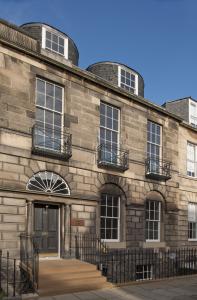
The Edinburgh Baha'i Centre at 44 Albany Street is a large Georgian House situated right in the heart of the City of Edinburgh. Georgian Architecture covers the period of 1720-1840. When Abdu'l-Baha visited Edinburgh in 1913, He stayed nearby in a similar Georgian building.
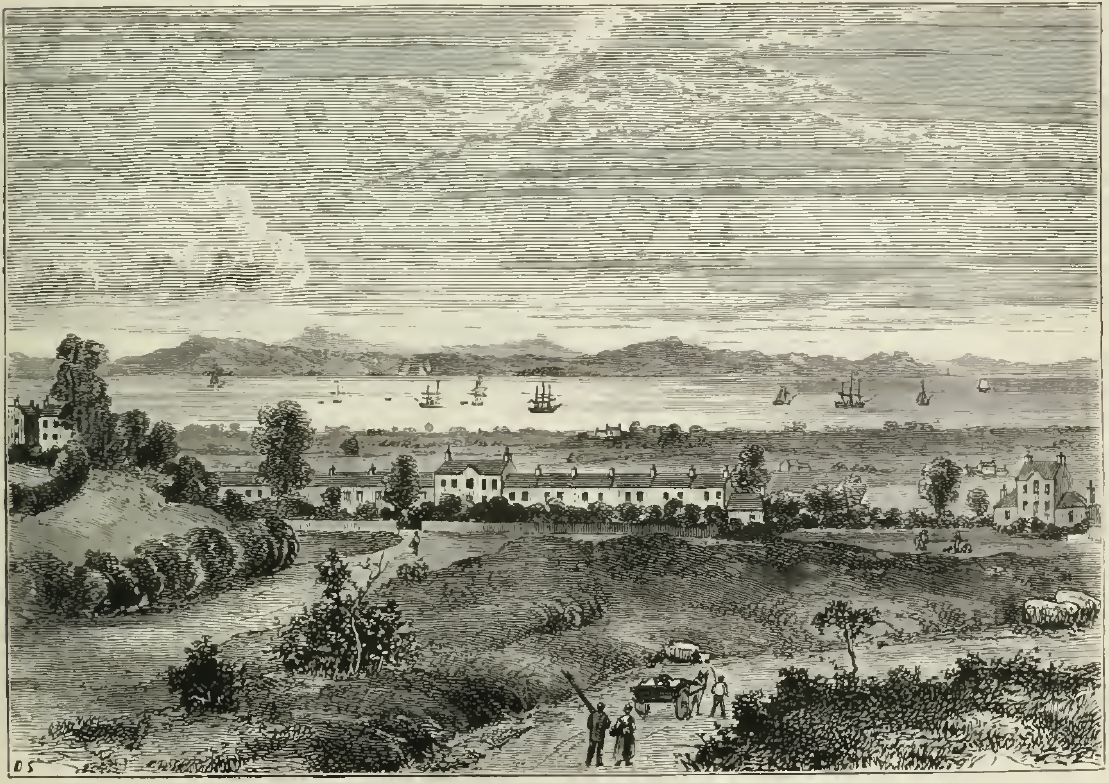
Originally, Edinburgh was much smaller than it is today, and when Albany Street began to be built, there was a clear view from it out of the City toward the sea, as can be seen in this drawing a few decades before from Picardy Place close by.
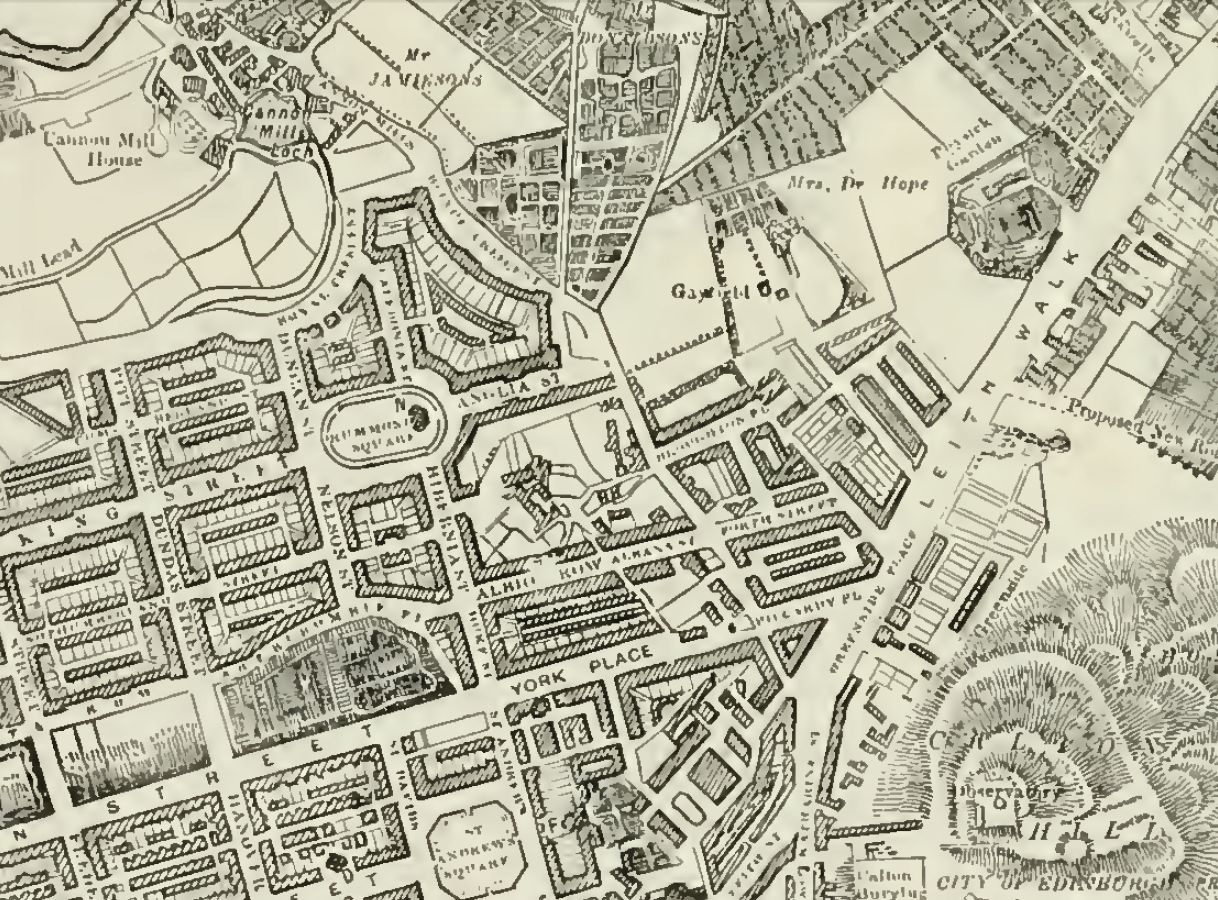
Then around the turn of the 1800s, the Northern New Town was built in the city, including Albany Street on its East. It was full of many colourful characters, as can be found in the pages of Cassell's Old and New Edinburgh covering the area (read now).
Work on Albany Street started in 1801, progressing from the low numbers to the high, with number 44 seeming to become occupied in 1818.
Albany Street was named from the title of the Second Son of the King of Scotland. It was often called Albany Row (occasionally Albion Row) for its first 20 years.
44 Albany Street itself was designed in about 1801 by William Sibbald.
William Sibbald (elder) was a Scots architect and builder, and Superintendent of Public Works in Edinburgh from 1790 until his death in 1809. He worked with Robert Reid on the layout of the first extension to the New Town, designed Lady Yester's Church in Edinburgh (1803), whilst his son, William Sibbald (junior), built the Bank of Scotland on the Mound, Edinburgh (1802–6), to designs by Reid and Richard Crichton (c.1771–1817) and died in 1823. Further work needs to clarify which of these two William Sibbalds, father or son, was the designer of the building.
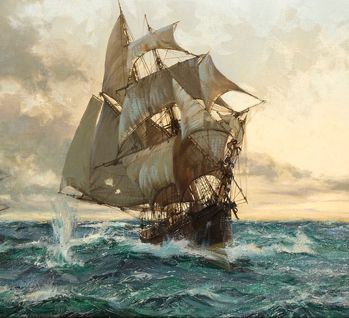
Captain William Ellis took up residence in 1818 until 1827. He was a sea captain, and in 1803 as captain of the Ross Cutter he married Miss Helen Mitchell. One can imagine he may have been away much of the time, and certainly we see that during this time, some other people stayed at the building.
One of these residents was Lady Davidson of Cantray. She lived in the building for 2 years from 1822-23, with Francis presumably her son winning a premium award in Latin Class, and a little after Mr Mitchell Ellis is vying with him for awards by receiving 2nd Prize in Second Highest Class for Gentlemen!
Lady Davidson of Cantray was presumably the wife of Sir David Davidson the Laird of Cantray in Inverness, who was born 1700 and knighted by King George III, unless the elderly wife of the previous Laird. There is a well-known tune called "The Lady of Cantray", companion piece to "Sir David Davidson of Cantray".
One imagines the Captain must perhaps have passed from this world in 1827 as the building becomes empty in 1828, and is hired out for 3 years to Robert H Barber and other operations, after which relatives move back in.
In 1831 we see one of these residents, R H Barber, signs a petition in the Scotsman with 150 others, demanding a public meeting of Edinburgh to consider addressing His Majesty on the recent dissolution of parliament and to express to the Lord Provost, Magistrates and Council that representation of the city be conferred on Rt Hon Francis Jeffrey, Lord Advocate of Scotland.
Father : William M Ellis (c1810-) 24
Son : William I Ellis (c1850-)
Mrs Ellis moved into 44 Albany Street in 1832. Mr William M(itchell) Ellis, presumably her son, was an Advocate and he appears here 2 years later, aged about 24.
William must have become of some importance since at Gräefenberg in 1843 as a Hydropathy patient (the curing of disease by the internal and external use of water), on receiving his card Dr Rishanek quoted him with a few others as a reference of recommendation for his work.
It seems that Mrs Ellis became ill and passed on, for she disappeared from the residence in 1844 and that same year contributed a sum of money to the Royal Infirmary of Edinburgh.
In late 1848 William married Emily, the younger daughter of John Anderson of St Petersburg, and as a notable marriage this was broadcast in the newspapers. Within a year they had given birth to a son. But Emily died within 6 days, no doubt from birth complications, and within months, the whole building went up for sale of all its "elegant furnishings". One imagines that, distraught at having scarcely got over one death and now his new wife's death and with a new baby child, Mr Ellis moves away to Duddingston where he lived with 2 servants, and at some time took up work as a corn merchant before returning to Advocacy. His child William disappears from the census before he is 11, and must either have died, gone to a boarding school, or moved with relatives. William himself passed on to the next world by the time he was 70.
Father's Father : James Milne (c1779-1863)
Father : John Milne (c1810-1885) 40
Mother : Elizabeth Sarah Law (c1823-1903) 27
Children : Elizabeth Law Milne (1845(c6)-1934) 14, Euphemia Milne (17 Mar 1847-1927/29) 13, James Milne (29 Dec 1848-22 Jan 1925) 2, John "Johnnie" Law Milne (31 May 1852 - 1 Jul 1908), Alexandrina Law Milne (16 Oct 1853-4 Jun 1943), Frederick Law Milne (27 Apr 1855-13 Aug 1943), William Law Milne (27 Oct 1856-20 Jan 1880?), Charles Law Milne (23 Dec 1865 - 26 Aug 1941)
After Mr Ellis' sad departure, the Milne family took up residence of the building.
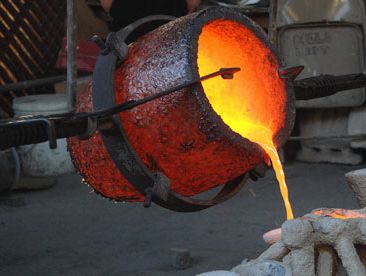
The head of the family that moved in was John Milne (1805-1885), working together in his father James's (c1779-1863) business, aptly named "James Milne and Son". They were engineers, brassfounders, gas meter manufacturers, and operated at Milton House at 90 Canongate until moving in 1885, this is now (rebuilt) as a school that you see there to this day. Undoubtedly the business passed from father to son when the son proved capable of taking over the reins. This son, John Milne, who lived at 44 Albany Street, was clearly and justifiably proud of the business, listing as his occupation that he was a "Brassfounder & Employing About 400 Hands". It was a wealthy establishment, and his father James lived in the palatial 10-bedroom Borthwick Hall, finally departing this world at 39 Lauriston Place on 21 April 1863, aged 82, and his name is inscribed in old curly handwriting on the Baha'i Centre window:
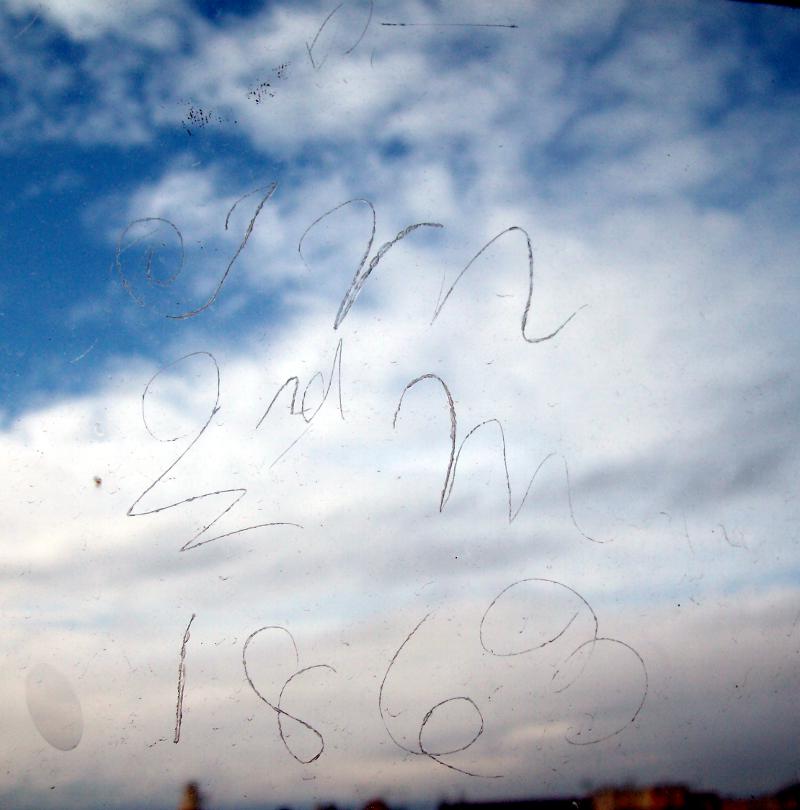
James Milne
J M
2nd May
1863
The 'Milne' in the etch isn't very easy to see at all, so when the etch was first discovered, before anyone know what the name was we had three people write what they saw down, and this is what they wrote -
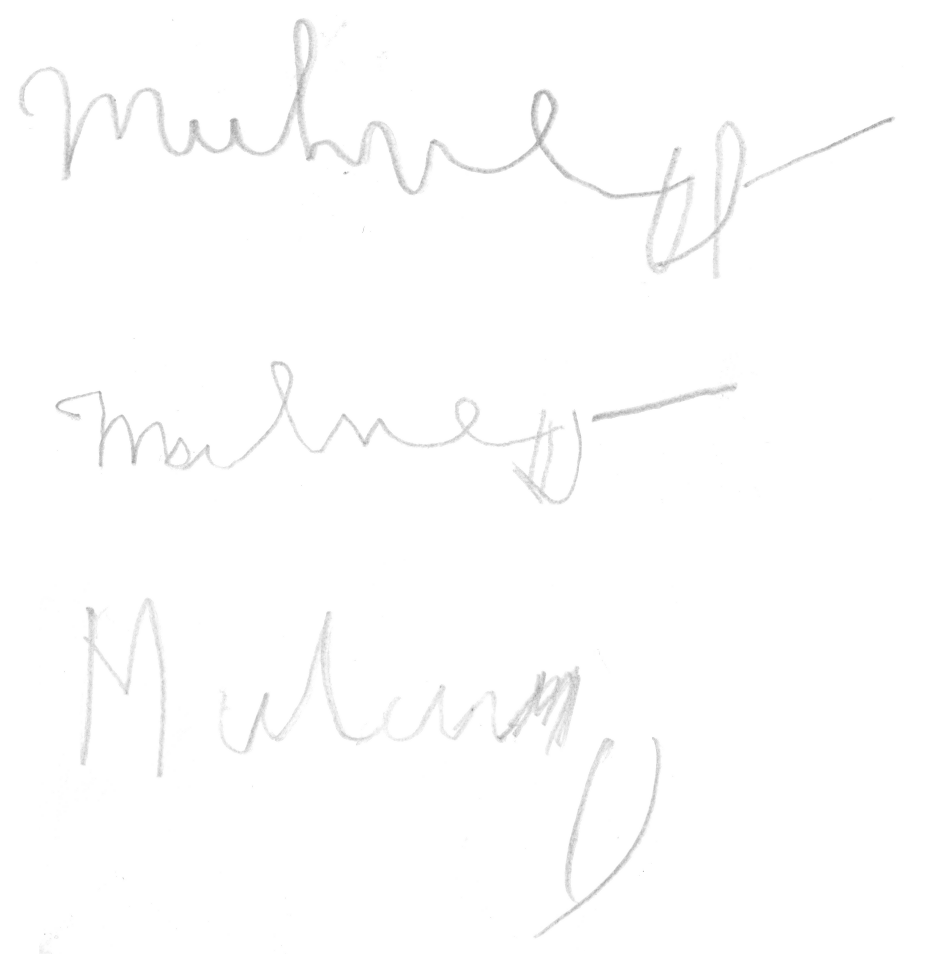
The J M here may well be this son, John Milne. This etching so obviously reflects a heartfelt relationship after so many years of work together, and an expression of great grief. Their engineering works would have provided an easy means to make the etch, perhaps with a diamond.
One cannot be too sure as to the reason for the slight difference in dates. Perhaps the family was away at the time and only heard of the passing on their return; perhaps in their grief it took a fortnight to collect themselves; perhaps, as is a common experience just after a loved one departs, they experienced an apparition of their father, and it might be this that is recorded; one can only speculate.
Extraordinary as this may seem, we therefore have etched on the upper floor window the most pivotal moment in Baha'i History; for it was on this date, 2nd May 1863, as the River receded, that everyone crossed over en masse for a final farewell to Baha'u'llah as He set off from the Ridvan Garden on 3rd May in triumphant departure into exile, embarking upon His public proclamation.
His mother passed to the greater world shortly after, no doubt in grief at her husband James's passing.
John Milne, as well as his profession in engineering, had many educational leanings. He was a Director of the Philosophical Institution at 4 Queen Street, which had the most noble goal, "to place within the reach of the Public the means of cultivating and extending the growing taste for Literature, Science and Art, and of acquiring full and authentic information on all topics both of immediate and permanent interest. For these ends there are provided - First, a SERIES of POPULAR LECTURES; Second, a READING-ROOM and LIBRARY; Third, a NEWS-ROOM." He was also on the Board of Examination for Schools and can be seen witnessing exams in Peebles, and he served as a Special Juror in an indictment case against a murderous doctor.
John Milne lived in 44 Albany Street with his wife Elizabeth Sarah Law (1823-1903) and their children Elizabeth, Euphemia, James, John, Alexandrina, Frederick, William and Charles, who all, except William, went on to marry and have children. There were 3 domestic servants and a governess for the children.
His son, James, named after his own father, grew up in the building and was a lifelong friend of the famous author Robert Louis Stevenson; they went to school together just up the road from Albany Street, came to the 44 Albany Street for children's parties, and visited Colinton Farm where Henrietta Traquair lived, who became James' wife. James left this colourful account of Robert Louis Stevension -
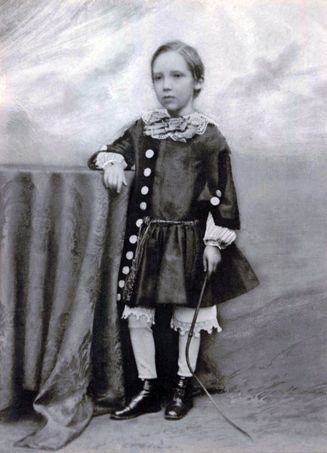
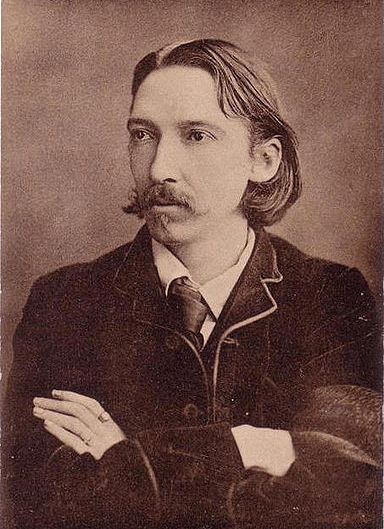
THE earliest I recollect of R. L. S. is his mother running him along Heriot Row in the mornings to warm him up on his way to Henderson's School in India Street, where we both went.
I also vividly recollect him one day in the Academy Yards in a towering rage. Some of the other kiddies were ragging him, and the rim of his straw hat was torn down and hanging in rings round his face and shoulders.
He always came to our children's parties, and my sisters and I went to Heriot Row on the two or three occasions there was a children's party there.
I well recollect R. L. S. at Peebles one day. Five or six of us were bathing in the Duckats, a rocky pool below Neidpath. It was a sunny day with a cold wind, and we did not waste much time in getting our clothes on; but Louis would continue to run about and play the fool in a state of nudity after all the rest of us were dressed.
At the University he and I belonged to the Dialectic Society the same year. It used to meet at eight or nine P.M., and often continue till eleven or twelve. When Stevenson turned up he always had something to say, and his remarks were always so very far from the mark that he provided material for all the later speakers to rag him. He usually bolted as soon as he had done speaking.
I never saw much of him at Colinton Farm; occasionally he came to our house, and frequently my wife and I were at Swanston while the Stevensons were living there ; but I have no outstanding recollections of him at Swanston - indeed I doubt if he often was there when we were.
We have an unpublished novelette of his, which he dashed off one wet Saturday when he was staying at Colinton Farm, or spending the day there. It is a very weird tale of the time of the plague in Edinburgh - thoroughly Stevensonian, written closely on both sides of seven or eight half-sheets of paper all different sizes. He made no corrections, and it requires none. He must have been about fourteen when he wrote it, and tossed it to my wife, who was a favourite cousin. She always kept it among her treasures.
The last time I saw Stevenson was at Heriot Row, when my wife and I went there to lunch and to say good-bye before he left for the South Seas. He could not come down to lunch, so I went and saw him in bed. He looked very frail and far through.
When he was 25, James married Robert Louis Stevenson's favourite cousin and childhood playfriend Henrietta Traquair (1850-1902), who was the daughter of Ramsay Traquair a farmer who owned Colinton Farm. Robert Louis Stevenson often depicted her in the characters of his books, and in the following letter he describes her recognising some of those characters and their antics in 'A Pirate Story' in 'Penny Whistles', which was the privately-printed trial issue of 'A Child's Garden', a pamphlet of forty-eight poems. She recognised herself and her brother William (1851-1923); they are commemorated in one of the Envoys to A Child's Garden:-
To Mrs Milne, Cointon Road, Edinburgh.
[? 23 October 1883] La Solitude
My dear Henrietta, Certainly; who else would they be? More by token, on that particular occasion, you were sailing under the title of Princess Royal; I, after a furious contest, under that of Prince Alfred; and Willie, still a little sulky, as the Prince of Wales. We were all in a buck basket about halfway between the swing and the gate; and I can still see the Pirate Squadron heave in sight upon the weather bow.
I wrote a piece besides on Giant Bunker: but I was not happily inspired, and it is condemned. Perhaps I'll try again; he was a horrid fellow, Giant Bunker! and some of my happiest hours were passed in pursuit of him. You were a capital fellow to play: how few there were who could! None better than yourself. I shall never forget some of the days at Bridge of Allan; they were one golden dream: see 'A Good Boy' in the Penny Whistles, much of the sentiment of which is taken direct from one evening at B. of A. when we had had a great play with the little Glasgow girl. Hallowed be that fat book of fairy tales! Do you remember acting the Fair One with Golden Locks? What a romantic drama! generally speaking, whenever I think of play, it is pretty certain that you will come into my head. I wrote a paper called 'Child's Play' once (published in the Cornhill Magazine in September 1878 and reprinted in Virginibus Puerisque), where, I believe, you or Willie would recognise things.
Yesterday I had toothache, and today I have a crick in my neck. These are details, but eloquent to me.
I wonder why Willie will be such an ass? he should be made to holiday - Willie-nilly. Tell him to write me a letter and I will answer it. I am taking my vacations at present, because of yesterday's toothache; my vacations generally last for twenty-four hours; but some day I mean to have a real [ ] (blank in the printed text) in idleness. Now when the work is stopped, the letters begin.
But what I want to know is, How about Mrs William Traquair? Surely Willie is just the man to marry; and if his wife wasn't a happy woman, I think I could tell her who was to blame, Is there no word of it? (William Traquair married Cecilia Ross Munro on 11 June 1884. When the news of the engagement reached RLS in December 1883, Fanny wrote to MIS: 'He was much excited and pleased over the news, and wrote instantly to Willie Traquair'.) Well, these things are beyond arrangement: and the wind bloweth where it Iisteth - which, I observe, is generally toward the west in Scotland. Here it prefers a south-easterly course and is called the Mistral - usually with an adjective in front. But if you will remember my yesterday's toothache and this morning's crick, you will be in a position to choose an adjective for yourself. Not that the wind is unhealthy; only when it comes strong, it is both very high and very cold, which makes it the d-v-l. But as I am writing to a lady I had better avoid this topic; winds requiring a great scope of language.
Please remember me to all at home; give Ramsay a pennyworth of acidulated drops for his good taste. And believe me, your affectionate cousin Robert Louis Stevenson.
In 1864, Elizabeth married John Doherty Barbour (1824–1901) of Ireland, one of whose children was the MP John Milne Barbour. This provides an interesting possible connection to 7 Charlotte Square where Abdu'l-Baha stayed, for of course Mrs Whyte's maiden name was Barbour.

After the Milnes, for a short period the 33-year-old George Henry Ebsworth (1838-1909) lived in the building.
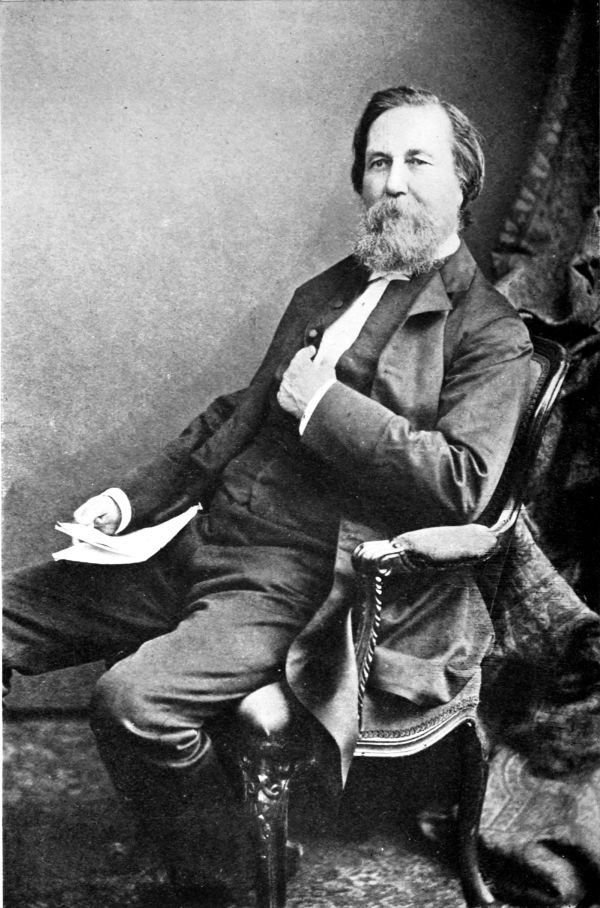
He came from a remarkable family. His father Joseph Ebsworth (1788-1868) was an exceptionally talented and energetic artist, adept at jewellery, opera, drama, music, linguistics and an amateur artist. Soon after 1826 he moved to Edinburgh, engaged at the Theatre Royal as actor and prompter and became established as teacher of music and singing, accepting the position of leader of the choir at St. Stephen's Church. From 1828 he ran an "English and foreign dramatic library and caricature repository" at 23 Elm Row, with concerts at the Hopetoun Rooms, Queen Street. He is buried at the Dean cemetery. His mother Mary Emma Ebsworth (1794–1881) was a dramatist, and his brother Joseph Woodfall Ebsworth (1824–1908) was a painter, engraver, and prose and verse writer, who became a priest. He left views of Edinburgh in all directions painted from atop the Scott Monument (see picture).
Such were George Ebsworth's notable family, whilst he himself was of quite a different calling. He tended to move around a lot and live as a lodger. Three years after marrying his wife Maria, he moved to Albany Street, having three children, Joseph (1869), Charles (1870), and Isabella (1872), who was born at 44 Albany St on Christmas day. Whilst living there, we find George as a corn merchant with his shop on Constitution Street in Leith, and also subscribing a large sum to fund opposition to the St Mary's Loch scheme, which began in July 1871 as a means of bringing in water for the City from the Loch 50km to the South; vigorous opposition to the plan caused it eventually to be dropped. He was an importer and exporter of fish and senior partner of Ebsworth & Hoeppner, Leith; but in a short space of time he became bankrupt (1877) and became a Commission Agent, his mother left for London, and his wife died shortly after (1879) aged only 47 and his children seem to have been looked after by others. We see him as a commercial agent (1881) and a newspaper porter and coal merchant (1901), before he himself passed away in the General Hospital, Leith, in 1909.
Father : Joseph Ebsworth (c1791-)
Mother : Mary Emma Ebsworth (c1781-)
Children : G Henry Ebsworth (c 1838) 33, Emilia M Ebsworth, Mary Emma Ebsworth, Charles Ebsworth, George H Ebsworth
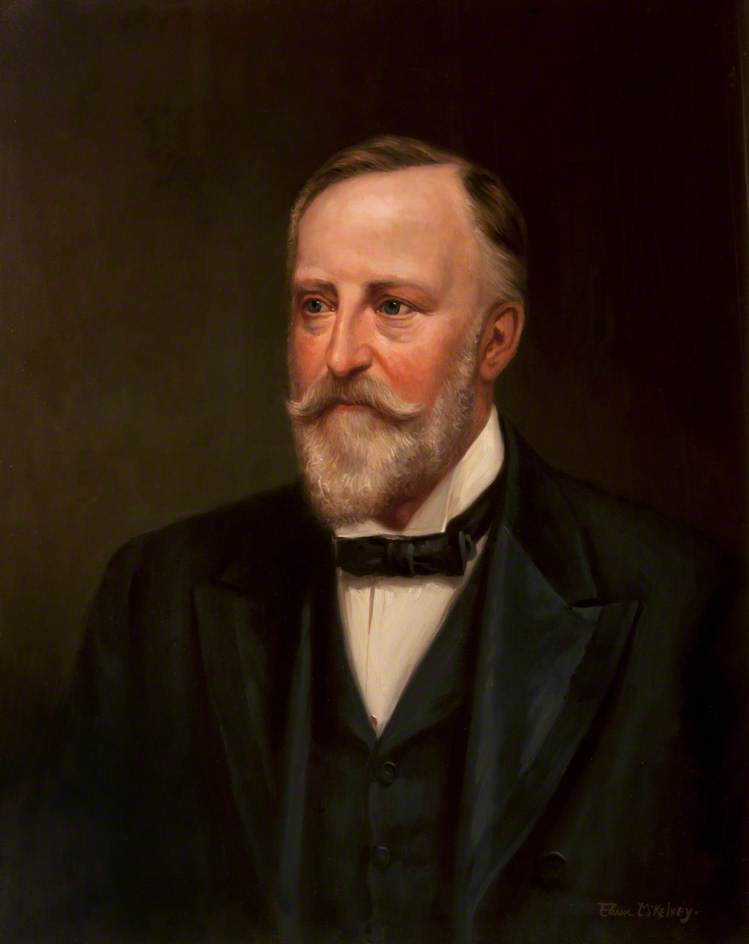
Father : John Graham MacDonald Burt, MD, FRCPE [=Fellow of the Royal Society of Edinburgh] (c1809-1868)
Mother : Susannah Louisa MacDonald (c1821-1877.05.19) 53
Children: Dora Burt (c1854-) 20, Henry Burt (c1856-) 18, Anna S M Burt (c1858-1886-12.09) 16, Charles Burt (c1859-) 15
Following the departure of Elmworth, Mrs Burt moved in with her children.
She had been married to John Burt, President (1863) of the Royal College of Physicians of Edinburgh (9-10 Queen St), and its Vice-President at the time of his death in 1868. On his death, a commemorative marble bust was made for the college. Mrs Burt moved with her children Dora (14), Henry (12), Anna (10), Charles (9) to 12 York Place, and then 5 years later to 44 Albany Street.
She passed on in 1877, and her children continued to live there. They had a black and white fox terrier pup, which at one point went missing with a reward out for it.
Henry and Charles are attacked in the newspapers at various times in 1880 as "New Tory Faggots for Midlothian", and this may explain their departure from the building that year.
The following beautiful tribute to Dr Burt appears in the Ediinburgh Medical Journal for March 1868 -
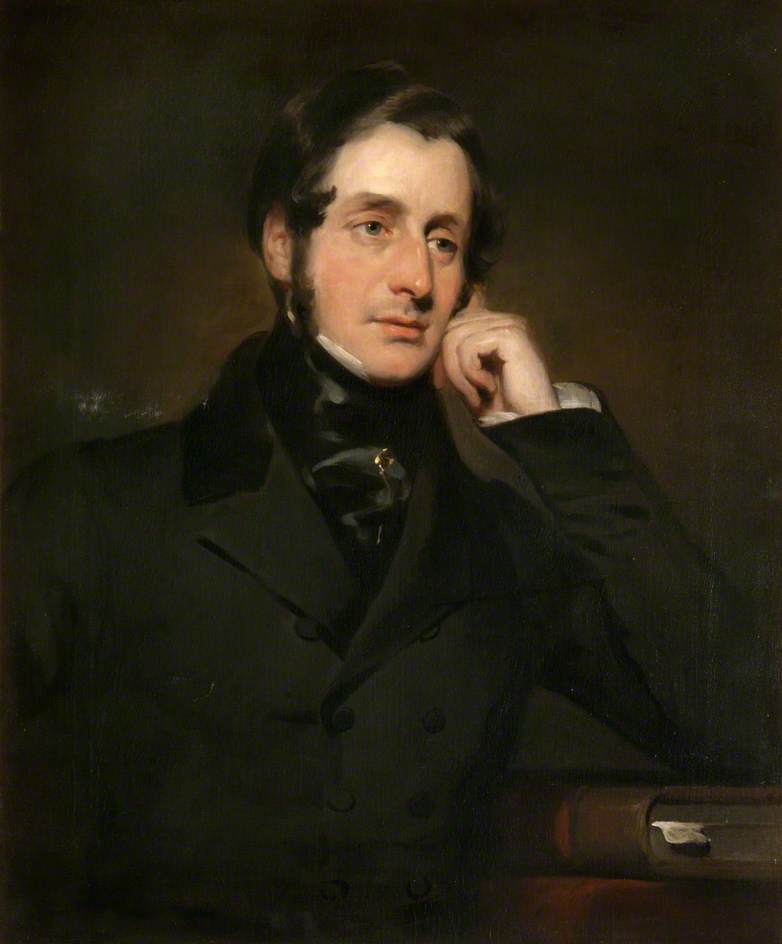
THE LATE DR BURT, F.R.C.P.E., F.R.S.E.
DR JOHN GRAHAM MACDONALD BURT died at his house in Edinburgh, on the forenoon of the 9th of February. He was seized on the night of the 2d February with erysipelas in the head, of which he had previously had several severe attacks. On the 6th it seemed to have yielded, and desquamation was taking place; on the 7th a red spot appeared on the back of the hand. This was the forerunner of diffuse inflammation of the cellular tissue, which rapidly extended, accompanied by failure of the circulation and delirium.
Dr Burt was in all respects an Edinburgh physician. His grandfather and father were respectable family practitioners in Edinburgh, and enjoyed a large share of public confidence. He was educated at the High School and Edinburgh University; and while travelling on the Continent he took his degree of M.D. at the University of Giessen in 1826. Three years afterwards, on his return to this country, he obtained by examination the licence of the Royal College of Surgeons of this city. In 1843 he joined the Royal College of Physicians, and was soon made a Councillor, and rapidly rose in the estimation of the College, until, in 1863, he was elected President. He assumed this office at a time when the College had been largely divided by discussions on the Medical Act, and, by his honesty of purpose and conciliatory manners, was very instrumental in restoring and establishing the peace and harmony which now prevail.
We cannot better show the estimation in which he was held in that body, than by quoting a minute prepared, we understand, at the request of the Council, by his friend Dr Alexander Wood, and which was unanimously adopted at a meeting of the College held on the 18th February:-
"Since the College last met, only fourteen days ago, the Fellows have been called on to follow to the grave the remains of one of their office-bearers. The College is constrained, under these circumstances, to record its sense of the loss which it has sustained by the death of Dr John Graham Macdonald Burt, a Trustee and Councillor of the College, and who was so recently the occupant of the Presidential Chair.
"Sagacious in counsel, shrewd in affairs, ready in debate, decided in opinion, emphatic and sententious in the expression of his views, warmly attached to the College, and grudging no labour or trouble to serve its interests, his removal from amongst us is a loss deeply to be deplored. The suddenness of his death increases the severity of the blow; while those who know the assiduous care and constant attention which he bestowed on every detail of the erection and adornment of the New Hall, will regret that he was not spared to witness the entire completion of a building which owes so much, to his tasteful superintendence.
"The loss which the whole College deplores will be more deeply felt by those who were brought into more immediate contact with him in the management of its affairs, and who were thus in a position to appreciate his many social qualities, and especially the strength and enduring character of his friendship, and the warmth of his kindly and loving heart.
"The qualities which made Dr Burt respected and beloved by all who were associated with him in public life, must have endeared him in no common degree to his immediate relatives and his family circle. To his bereaved widow and children the College would beg respectfully to tender an expression of deep sympathy, and do hereby direct that a copy of this minute be forwarded to [869] Mrs Burt, that she may be assured how many appreciated his many excellencies, and unite with her in deploring his loss."
Dr Burt was also a Councillor of the Royal Society of Edinburgh; and, in taking the chair at the meeting after his death, Dr Lyon Playfair, C.B., the Vice-President, alluded to the removal of his colleague in these feeling terms:-
"Dr Burt, a member of our Council, was well known as a public-spirited citizen, who has long usefully devoted himself to the development of our institutions, and who, by his genial disposition and honesty of character, endeared himself to all those who enjoyed his acquaintance."
By his mother Dr Burt was associated with an old Scottish family not unknown in the military annals of our country, and from her side of the house he seems to have imbibed that taste for arms which led him to hold the office of Surgeon to the Mid-Lothian Yeomanry corps; Surgeon to the Royal Company of Archers, Her Majesty’s Body Guard for Scotland; and Surgeon to the Edinburgh Artillery Volunteers. He was also Surgeon to his late Majesty in Scotland. He early succeeded his father as Consulting Physician to the North British Insurance Office, - an appointment which he held to the day of his death, and in which he proved himself not only the adviser but the friend of the Directors of that prosperous Institution.
Dr Burt’s eminent social qualities led his company to be much sought after, and deprived him of that leisure which might have made him a contributor to the literature of the profession. Early in life, however, he showed that love of art and good taste for which he was afterwards conspicuous, by the publication of some excellent drawings of Surgical Anatomy. He also contributed one or two papers to this Journal.
The same cause, to a certain extent, prevented Dr Burt from keeping himself abreast of the rapid progress of Medical Science, but the foundations of that noble study had been securely laid in his student days. As a practitioner, his sound practical sense, ready recognition of disease, and thorough knowledge of human nature, made his advice ever sound and reliable. Where severe disease or acute suffering were to be combated, there were none more attentive or more tender than he was. He perhaps had not enough patience for the minor ills and discomforts to which flesh is heir, and which often occasion more real distress than serious diseases; his honest and true nature shrunk from the petty arts by which many have crept into favour. He never pretended an interest which he did not feel, nor simulated an attention which the exigencies of the case did not demand.
Amidst the many dissensions which divided the medical practitioners in Edinburgh, Dr Burt always preserved his own position, and stood well with and was trusted by all parties; and he never ceased to deplore what in practice he failed to acknowledge, - the social separations which public differences of opinion in many cases involved. His friendship, once given, was never causelessly withdrawn, and no man ever lived who more willingly and cordially served a friend.
Scarcely a fortnight before his death, he was gratified at receiving the elegant volume by Sir Wm. Pergusson entitled "Lectures on the Progress of Anatomy and Surgery," and dedicated to him in the following just terms:- "This volume is inscribed to Dr JOHN G. M. BURT, F.R.S.E., late President of the Royal College of Physicians of Edinburgh, etc., etc., in testimony of his professional eminence and social worth, and in affectionate remembrance of an uninterrupted [870] friendship of more than forty years, by his early schoolfellow, the Author."
Nor was Dr Burt unmindful of his duties as a citizen. Early in life he was a High Constable of Edinburgh, and for many years, and until that body was merged in the Town Council, an active Commissioner of Police. For a long period he represented the College of Physicians at the Board of the Royal Infirmary, an office from which he only retired in January last.
He took a warm interest in municipal affairs, and had considerable influence in his Ward. No one who witnessed the scene will easily forget the coolness, courage, and determination with which he forced an unwilling audience to hear him when the representation of his Ward was very keenly contested in 1866.
He was interred in the Dean Cemetery on the 14th of February, and although it was the wish of his relatives that the funeral should be as quietly conducted as possible, yet, despite the tempestuous character of the day, few private citizens have ever been followed to the grave by a larger number of friends anxious to pay the last tribute of respect to their memory.
The two sisters Jane and Alice Anne MacKenzie, daughters of the late Richard of Dolphinton, took up residence in the building. Within months, Jane passed on, leaving Alice who remained in the building for 16 years, apparently after second thoughts on selling the house. When she passed away in 1897, the contents of the building were auctioned off and the building was empty for a year.
It is there described as:-
The Desirable Self-Contained House, No. 44 Albany Street, consisting of Dining-Room, Drawing-Room, and Bed-Room Floors, with Kitchen, Servants' Apartments, Bath-Room, Washing-House, &c, and Excellent Back Garden.
MacKenzie & Kermack were given as contact for the title deeds.
Mother : Maria A McLaren (c1820) 79
Children : Maria B McLaren (c1851-) 48, Beatrice E McLaren (c1853-) 46, Marion A McLaren (c1855-) 44, John D McLaren (c1859-1908) 40, Alice T McLaren (c1861-) 38
The McLaren family moved in just a few doors from 52 Albany Street, John, a Chemical Marine Manufacturer, and his two sisters Maria and Beatrice, and it seems at first a fourth. They had a Tablemaid and a Cook.
The neighbouring house, 42 Albany Street, was owned by James McLaren and Sons, for 10 years as a wholesale tea dealer.
David passed on in 1908, and the funeral procession set out from 44 Albany Street to Warriston Cemetery.
All the contents, silverware and jewellery were auctioned off.
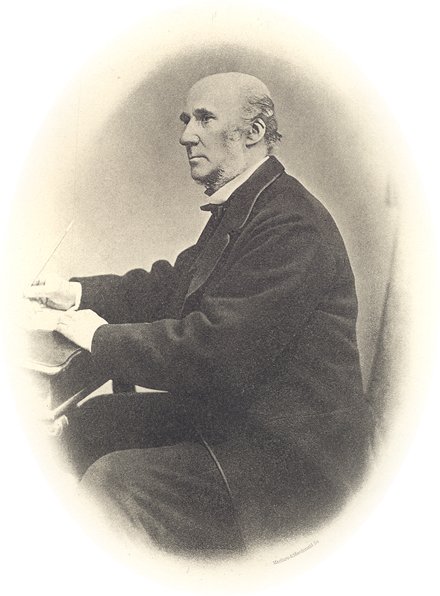
Mother : Mary Catherine Borthwick Honorable 1846-1928, daughter of Lord Archibald Borthwick, de Jure fifteenth Baron Borthwick.
Children : Mary Louisa Spens (1871-), Janet Ariana Spens (1872-1951), William Spens (1874-1916), Ariana Borthwick Spens (1876-), Alice Cunningham Spens (1878-1943), Archibald Borthwick Spens (1879-1966), Walter George Spens (1885-1977).
The period of 1908-1951 sees the building in the hands of the Spens family.
William George Spens (1845-1916) was a Glaswegian, living there most of his life. He was Secretary of the Scottish Amicable Life Assurance Company managed by his father William Spens, of whom it is said,
Those who remember Mr. Spens cannot forget the charm and geniality of his manner, which was characterized by simplicity and gentleness very seldom met with. All his thoughts and feelings were influenced by a high sense of honour - "He bore without abuse the grand old name of gentleman."
When he was 24 he married (in Edinburgh) the Honourable Mary Catherine Borthwick. Together they had 7 children: Mary, Janet, William, Ariana, Alice, Archibald, and Walter. He and his wife moved into the building in 1908, at which time just Walter was still living with them aged 23, and he moved out by the next year.
Perhaps it is not a coincidence that his sister Joanna married John Ord Mackenzie (4th of Dolphinton), as the building had been a MacKenzie home just before the previous owner.
William passed away suddenly just before Christmas 1916, and a service was held at Mary's Cathedral, Palmerston Place, from where he was buried in Dean Cemetery.
Mary continued to uphold the building, losing children in the War, and with her own passing in 1928 the building passed on to her daughter Janet Ariana ("Netta") who in 1917 had married Reverend Dr Arthur H Power in a quiet wedding. It must have been a terrible blow that he too passed away that year.
The last notice we have is of a lost short amber necklace in 1935.
Janet contined to live there with her brother Walter G Spens, until she passed away there in 1951, at which point Walter moved away.
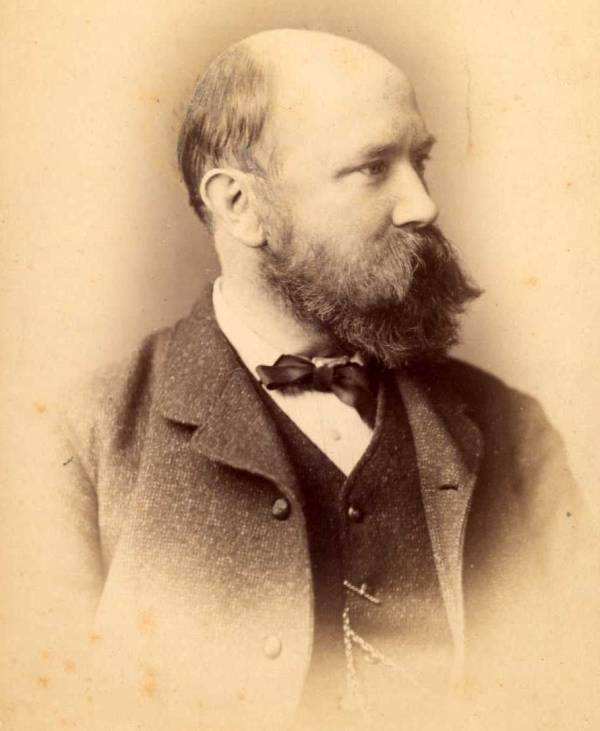
Subsequent at some time to the Spens ownership, Dugald William McTaggart is associated with the building. Perhaps he intended to live in the building itself, but in the end it seems to have become used for non-residential purposes.
Dugald was born in 1917 in Lasswade to a family famous for its painting history; schooled in Edinburgh he moved to Australia with his parents when he was 16. His father was a mechanical engineer and eldest son of the second marriage of the famous Scottish painter William McTaggart (1835-1910) (view his paintings). Dugald took holy orders as a minister of the Presbyterian Church of Australia and was an army chaplain in the Australian Northern Territitories. But the hot temperature and ill health forced him to return (1946), allowing him to marry and do post-graduate work at Edinburgh University. He married Janet, and held from prior to his return, 1942-1960, some kind of residence in Glasgow. His involvement with 44 Albany Street will perhaps have arisen with his post-graduate work at Edinburgh, and may have represented an operation in the city. As well as his church calling, Dugald was a registered mason.
In Oct 1964, the building was Grade-A listed.
In 1966, at the time Dugald sold it to the WRVS, the large front room at ground level was used as a Clothes Store with the large rear room used for sorting clothes, the third room at the back is marked 'Hospital Car Service', whilst the basement rear of the building was a garden with an access door to the lane; the building is described (and drawn) as having basement (three rooms - the current prayer room was divided by a passageway), Ground (three rooms), First (conference room and four rooms) and Second (four rooms).
In selling the building, he retained a renting lease on it until 1976; but he sadly died within a year, in 1967 in Stirlingshire, where he held a ministry.
Articles in Australian newspapers from his time there give a flavour of the man and his mission, along with other advertisements of his preaching, such as the following -
IN CANBERRA CHURCHES
MESSAGE TO COMFORT TO OUTBACK
Preaching at St. Andrew's Church yesterday morning, the Rev. Dugald McTaggart, of the Australian Inland Missions, said that we must seek for the risen Christ, not in the tombs of the dead but in the present and the living. We find Him working through the lives of men in whom He dwells and there the resurrection message had most of its meaning. That was the experience of the men who pioneered the outbacks of Australia and who were denied the comfort of homes and companionship.
Mr. McTaggart spoke of the work which the Australian Inland Mission had done in the establishment of the flying doctor service and the pedal wireless which had broken down the isolation of the outback and had made happy home life possible. Those services had also demonstrated to the people in the lonely outposts that they were not forgotten by the world or by Christian people. The spirit which permeated others to take an interest in them was something which showed them that Christ was still working in the lives of men.
1944-04-10 The Canberra Times
When The Tide of War Reached Alice Springs
WAR had brought great changes to Alice Springs. Many of the people had felt in the past two years that they were strangers in their own towns, said Rev. Dugald W. McTaggart, B.A., B.D., who is attached to the Australian Inland Mission, this week.
Thousands of soldiers and C.C.C. workers have settled down there. The wide streets, where the "silent cop" is sometimes a eucalypt growing casually in the middle of the road, are now filled with semi-trailers and blitz-buggies. The railway station, once so peaceful, which formerly had to cope with one train per week, now witnesses the arrival of several per day.
"When I first arrived in the Alice, things were almost normal," declared Mr. McTaggart. ''The train was fourteen hours late, but no one minded very much - except the passengers who had to pay for two extra meals. In the evenings when we sat on the lawns of the A.I.M. Hostel there was scarcely a sound except for the creaking and the whirring of the small windmills in each garden. The atmosphere was typically outback, where there is always plenty of time.
"My next visit was very different. In the meantime the Japs had bombed Darwin, and the Alice folk had been digging slit trenches. The Army had commandeered the A.I.M. Hostel for use as a nurses' quarters. There were rumours that all civilians were to be evacuated. Soon, however, things settled down. The civilians grew accustomed to the sight of marching troops and bugle calls."
Of the night life that war brought to the Alice, Mr. McTaggart draws a vivid picture. "On a recent evening I sat on the steps of the monument on Anzac Hill. Behind me were the low foothills which continue for a dozen miles north of the town, and ahead was the high escarpment of the Macdonnells, a high red wall in the setting sun, cut by the sand bed of the Todd at Heavitree Gap. The red hills stretched to the West until they were softened by the blue haze.
"'Below, the town was getting ready for the night. Soldiers were strolling through the streets, and the three open-air picture houses were playing music before the shows started.
"'I could hear now the cheerful whistle of a leave train, crowded with troops, pulling out of the station. Then night, with the suddenness of the tropics, was on the town, the dim shapes of trees and houses faded, and left only the street lights and the stars.
'These are the kind of memories the soldiers will carry back to their homes," said Mr. McTaggart. "After the long journey South, through gibber plains and sand hills, or the monotonous trip up the track and back, the green freshness of Alice Springs heartens the most weary and grimy traveller."
The A.I.M. Hostel, which was built In 1926, became the hospital for the whole district until 1939 when it become a convalescent and rest home for the women of the inland. Commandeered by the Army, its services today are sorely missed. Padres are continually being asked by the mothers of small children. "When is the Hostel going to open again?" For now, when in hospital, these women face another tremendous anxiety because, with the A.I.M. closed, there is no place where their children can be temporarily taken care of.
1945-08-17 The Farmer and Settler
CHARLIE MAYNARD AND A.I.M. TALKING of Central Australia reminds me that the Rev. Dugald McTaggart (a patrol padre of the Australian Inland Mission) tells me that Charlie Maynard, one of Alice Springs old hands is a patient in the AIM hostel at Beltana
Years ago. when the first AIM sisters went up to the Alice, the hostel was not quite ready to accommodate. So Charlie Maynard gallantly gave them the use of his House for several months. Three years ago he was in Alice Springs AIM hospital, but was evacuated south, and has been at Beltana ever since. He is in bed, and is almost blind, but welcomes a yarn about early days in the Alice.
The Army ban on people going through Heavitree Gap into Alice Springs without a special pass is nothing new he said the other day. Years ago the gap had sacred significance to the aborigines, and no lubra dared go through. She had to climb 1,000 feet over the range instead. Later, when the railway was being built, all cars going through the gap were searched by a police guard to see that no liquor was carried to the rail gangs.
The AIM plans to establish a home in the interior for old hands like Charlie Maynard, and Adelaide people will be able to help achieve this objective on Friday by buying an AIM badge in the city.
1945-09-11 The Advertiser, p6
Wife : Janet Christian Martin
Father : Joseph Henderson McTaggart (13 Aug 1890 Lasswade) son of artist William McTaggart (1835-1910)
Died : 24 Jul 1967 at West Park House, Duke Street, Denny, Stirlingshire
The building was purchased in 1966 by the Women's Royal Voluntary Service, a voluntary organization concerned with helping people in need throughout England, Scotland and Wales, and the largest voluntary organisation in British history, at its height having one million members.
In the 1960s and 1970s the building was the WRVS district office for Edinburgh (Lothian), mainly used for administration. A lease was present on the building until 1976.
Then, from the late 1970s to the early 1980s, at one time or other, the Local Authority made use of some of the rooms to run a single parent family support service.
In 1986-7 it was used for emergency service training, and to interview potential volunteers.
It was also used as a Clothing Store, where volunteers often met to knit together for various causes such as knitting baby clothes. In January 1996, the clothing store was moved to two floors in 30 Albany Street.
Another main use for the building was for the Books on Wheels Service for the Housebound, which celebrated it's 25th Anniversary in 1989. This service was slowly moved to other areas/buildings in the 1990s, and hoped to run its book stock down if running the scheme from Blackhall Library was successful; in 1996 the Books on Wheels vacated the premises and became a van service.
From late 2001 MORI took up the top three floors of the building with WRVS as the owners remaining in the basement running community services, up until their selling the building in 2005.
And so, after this long history through time, the Baha'i Community took up ownership of the building on 23 May 2005; and after refurbishment in 2010, on 23 May 2011 the Edinburgh Baha'i Centre was officially opened.
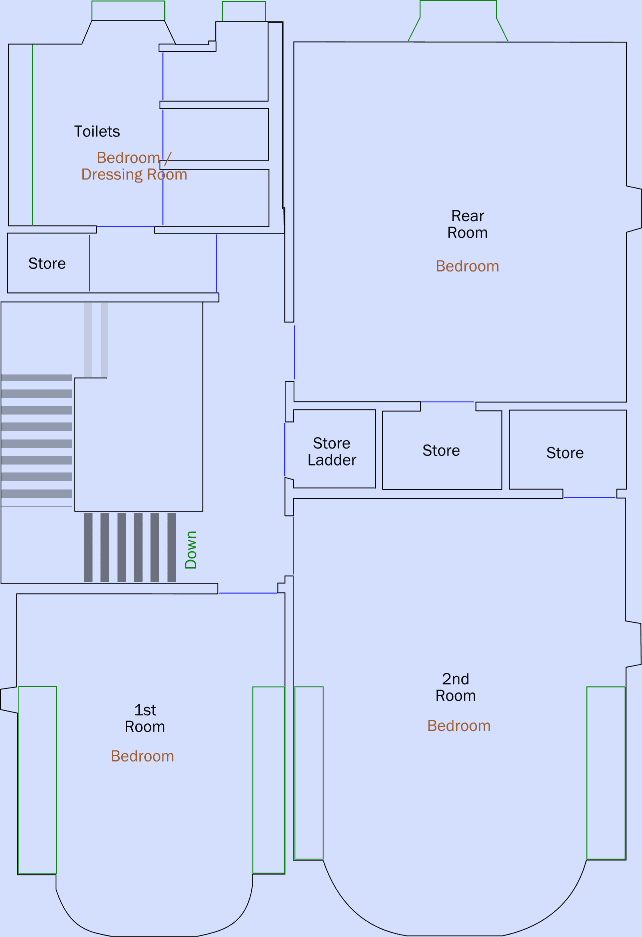
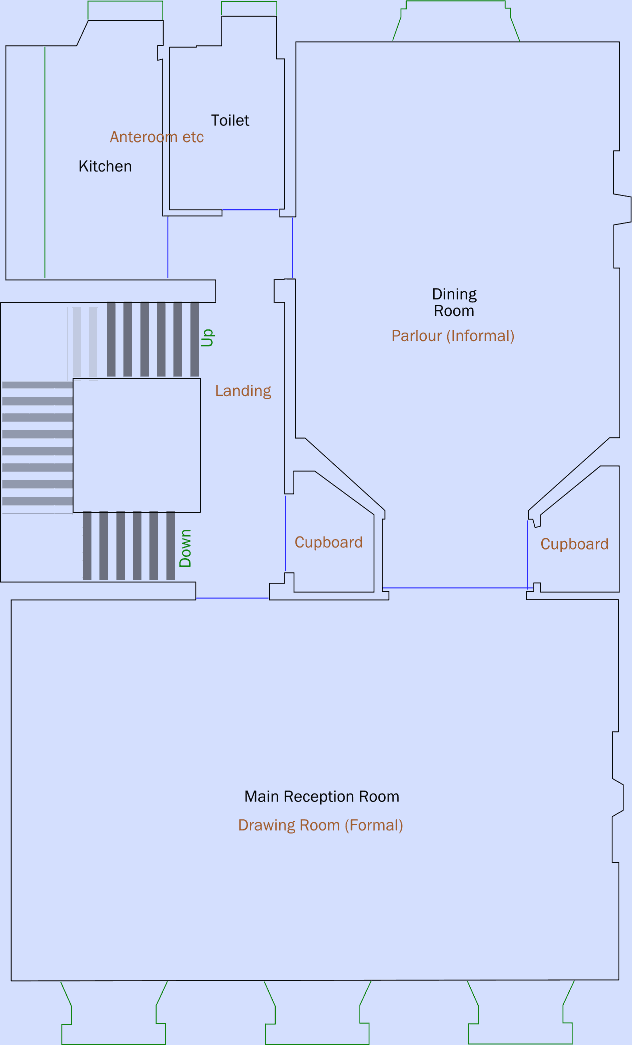
What follows, is the plan of each level of the building, with expected original room uses in brown, compared to their current use in black; rooms and tasks are depicted on the right through representative pictures of the time.
The Basement would have been where the servants resided and did their work.
At the rear of the building is an exit that has been bricked up. Perhaps this was to the old "Wash House" mentioned in the adverts, or some other room. The cellars at the front under the street were perhaps for coal and wood.
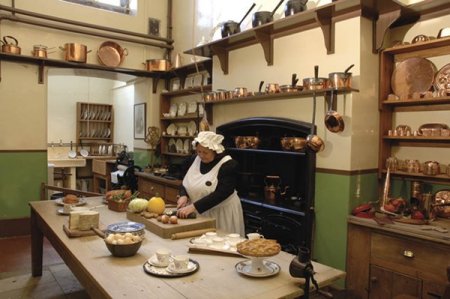
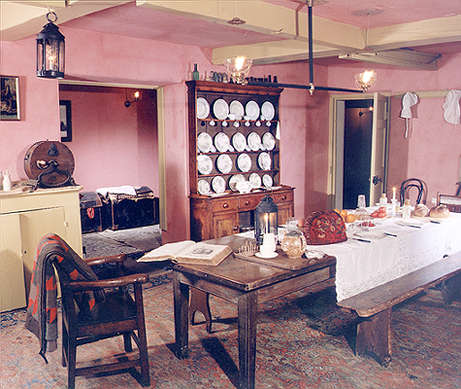
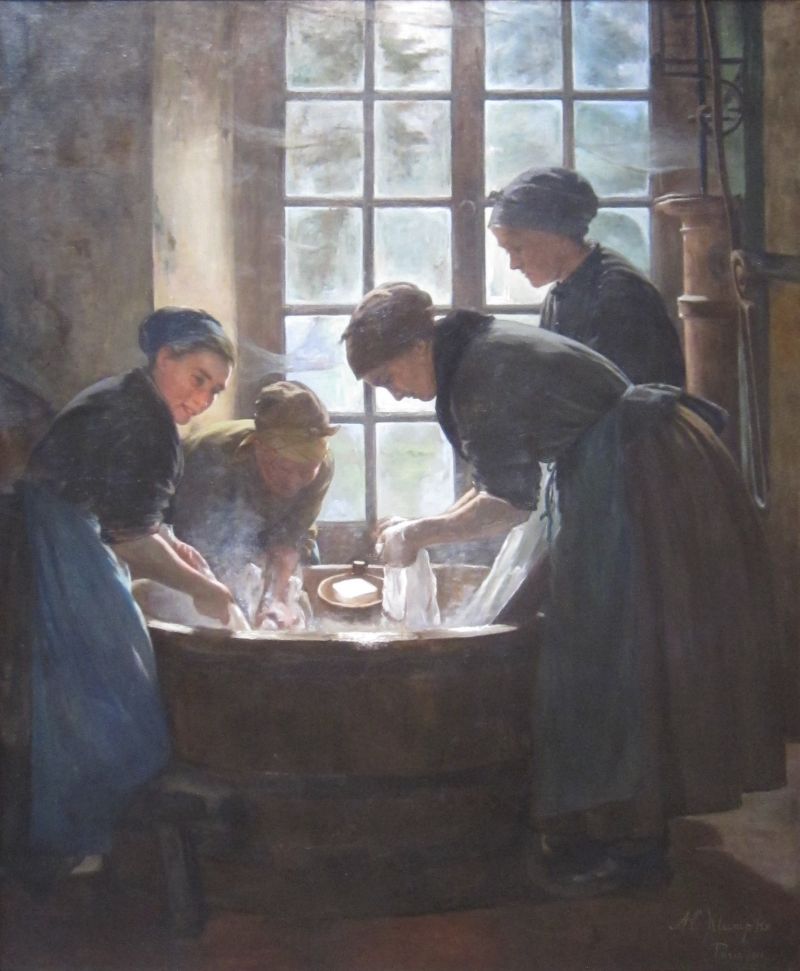
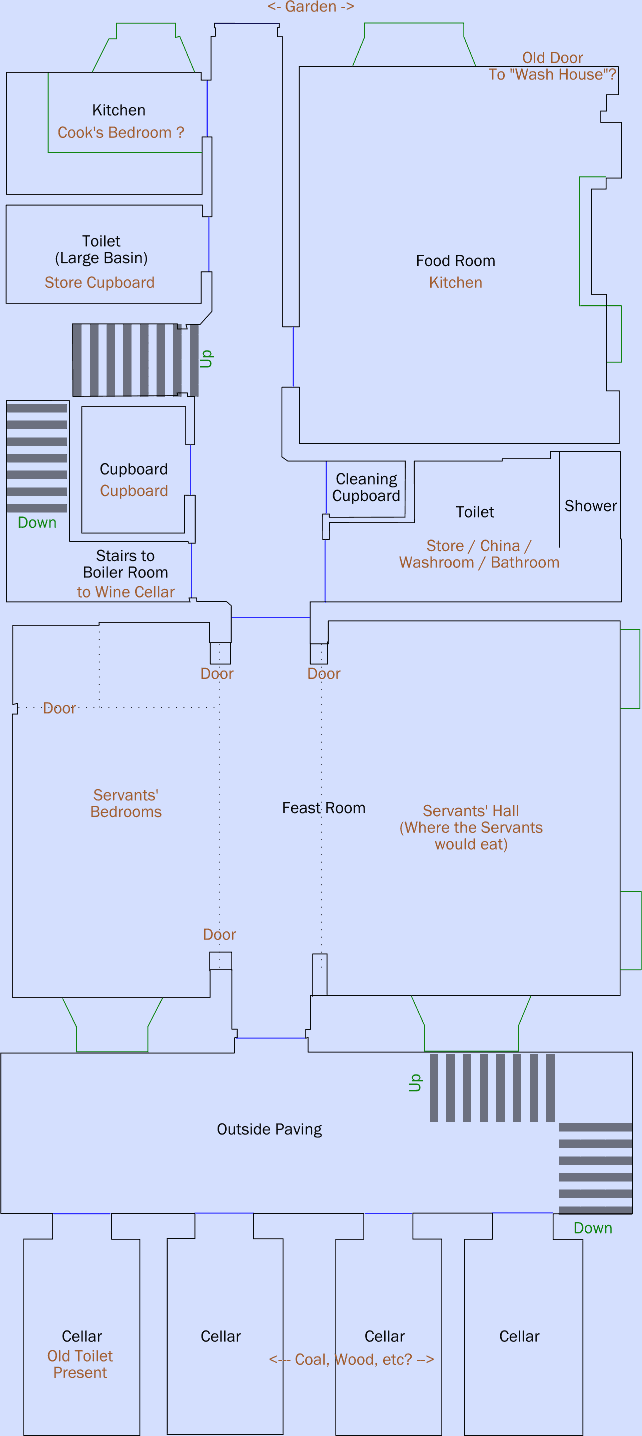
The Ground will have seen the main dining room at the entrance, and the master bedroom to the rear.
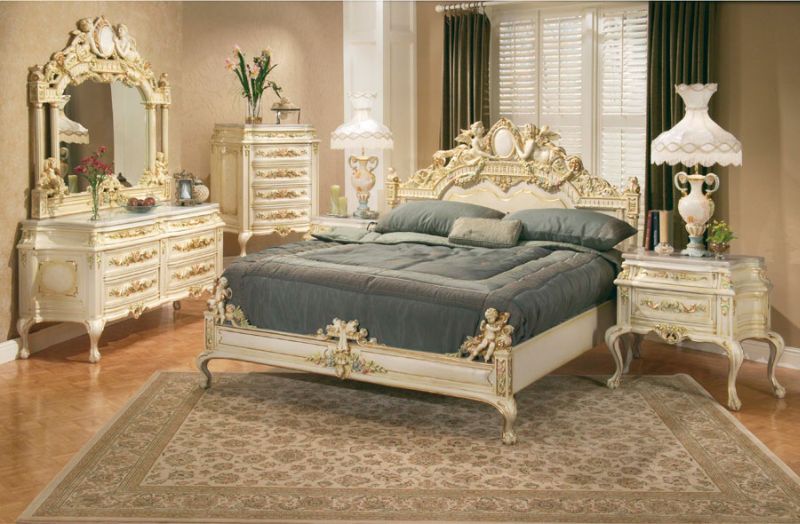
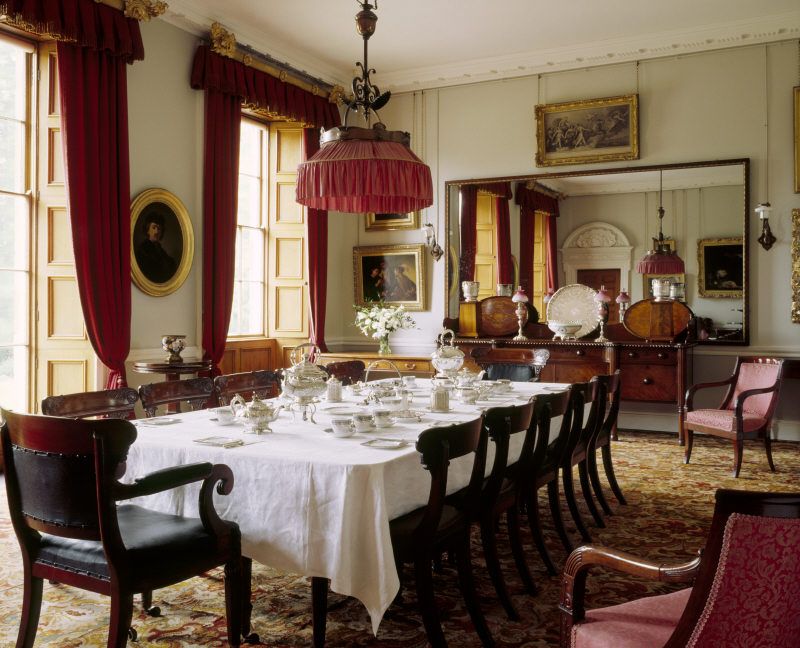
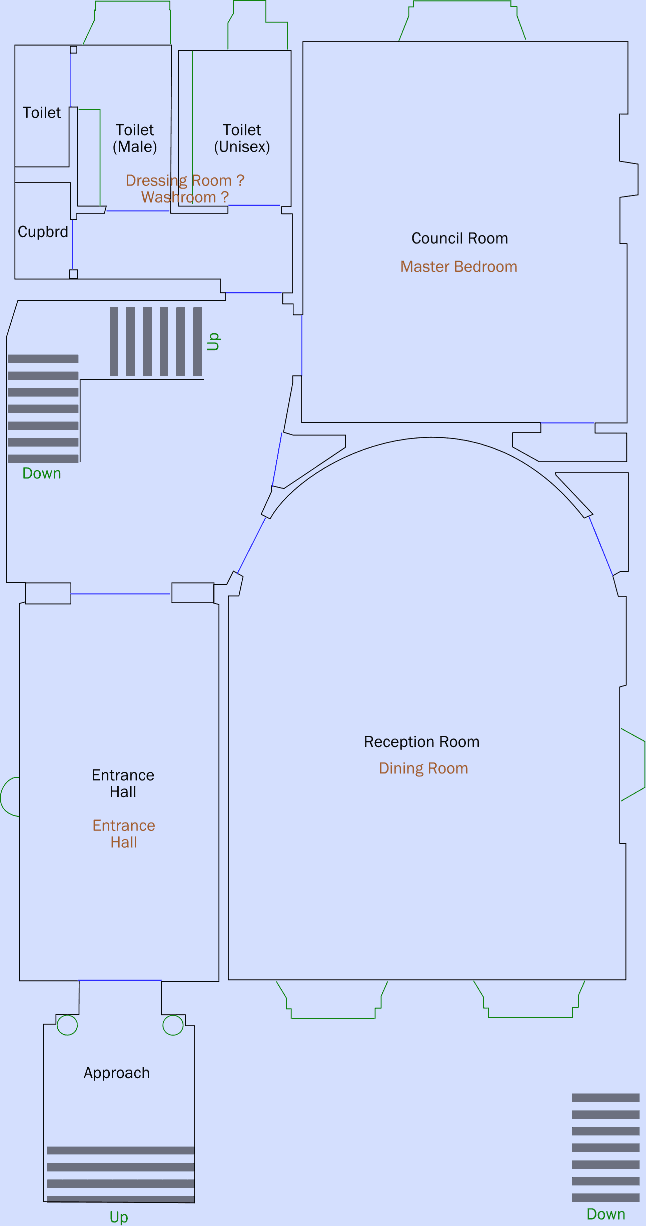
The First Floor will have seen the main meeting and mingling rooms - the Drawing Room and Parlour.
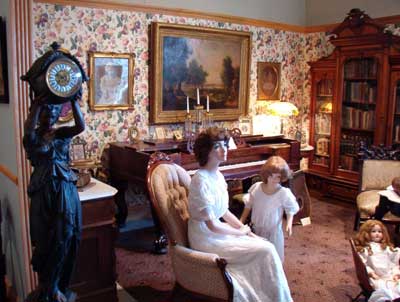
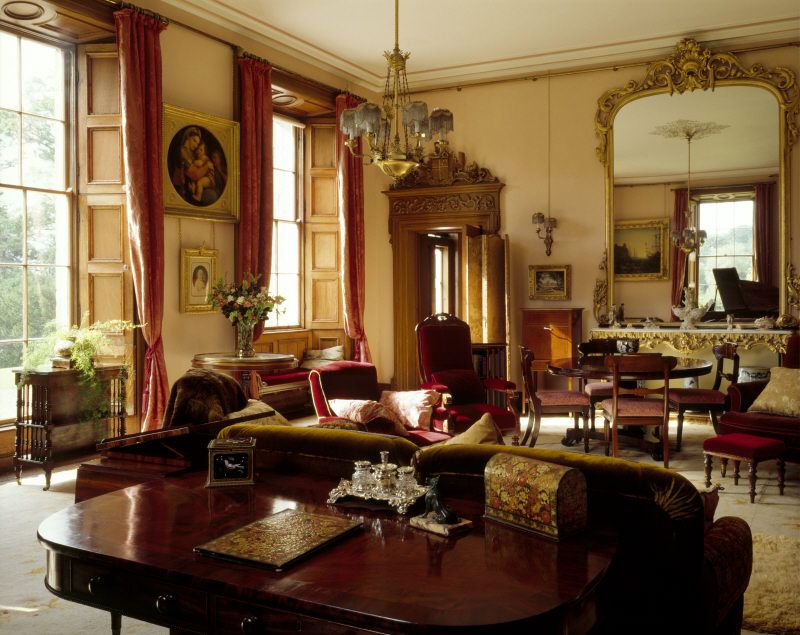
The Top Floor will have seen the general bedrooms.